Why Are iPhones More Expensive Than Samsung?
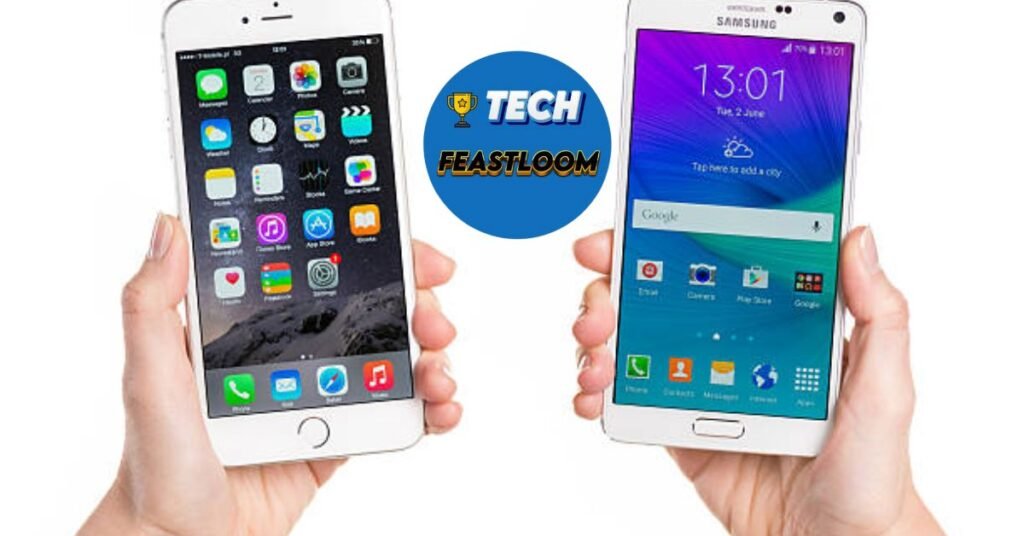
Have you ever wondered why iPhones consistently command higher prices than seemingly comparable Samsung phones? You’re not alone – this question generates over 2 million searches annually as consumers try to understand the significant price gap between these tech giants. Whether you’re debating your next phone purchase or simply curious about the economics behind smartphone pricing, this comprehensive FAQ will reveal the real reasons behind Apple’s premium pricing strategy and help you determine if the extra cost delivers genuine value, iPhone vs Samsung Price.
In this detailed guide, we’ll answer the 12 most searched questions about iPhone vs Samsung pricing, backed by industry insights and real-world comparisons. From manufacturing costs to resale values, we’ll uncover every factor that contributes to the price difference and help you make an informed decision about which ecosystem offers better value for your specific needs.
Frequently Asked Questions
What Makes iPhones More Expensive Than Samsung Phones?
Quick Answer: iPhones cost more due to Apple’s proprietary ecosystem, premium materials, exclusive iOS software, and strong brand positioning that allows premium pricing.
The price difference stems from multiple factors working together. Apple designs and controls every aspect of the iPhone experience, from the custom A-series processors to the iOS operating system. This vertical integration requires massive research and development investments – Apple spends over $30 billion annually on R&D. Unlike Samsung, which uses Android and sources components from various suppliers, Apple’s closed ecosystem demands higher upfront costs that get passed to consumers.
- Proprietary hardware: Custom-designed chips like the A17 Pro cost significantly more to develop than off-the-shelf Snapdragon processors
- Premium materials: Surgical-grade stainless steel, ceramic shield glass, and titanium frames increase manufacturing costs by 30-40%
- Brand value: Apple’s brand commands a premium – consumers pay extra for the status symbol and perceived quality
- Software exclusivity: iOS development and updates for 5-7 years add substantial ongoing costs
Additionally, Apple maintains strict quality control with lower tolerance for defects, resulting in higher manufacturing costs but more consistent product quality across all units.
✅ Best for: Users who value seamless ecosystem integration and long-term software support

Why Are iPhones More Expensive Than Samsung?
How Much Does an iPhone Cost Compared to Samsung?
Quick Answer: New iPhones range from $429 to $1,599, while comparable Samsung phones cost $200 to $1,299, making iPhones typically $200-$400 more expensive at each tier.
The pricing gap varies significantly depending on the model tier you’re comparing. Entry-level iPhones like the iPhone SE start at $429, while Samsung’s budget A-series begins at just $199. In the flagship category, the iPhone 15 Pro Max reaches $1,599, compared to the Samsung Galaxy S24 Ultra at $1,299. This $300 difference in flagship pricing has remained consistent for the past three years.
- Budget tier: iPhone SE ($429) vs Samsung Galaxy A54 ($449) – nearly equal pricing
- Mid-range: iPhone 15 ($799) vs Samsung Galaxy S24 ($799) – competitive pricing in 2024
- Premium tier: iPhone 15 Pro ($999) vs Samsung Galaxy S24+ ($999) – matched pricing
- Ultra-premium: iPhone 15 Pro Max ($1,199-$1,599) vs Galaxy S24 Ultra ($1,299-$1,419) – iPhone costs $100-$180 more for equivalent storage
However, actual purchase prices differ significantly from MSRP. Samsung typically offers $200-$400 trade-in bonuses and carrier promotions within months of launch, while Apple maintains stricter pricing control with smaller discounts.
💰 Price range comparison: iPhone ecosystem total cost averages $1,200-$3,500 (phone + accessories + services) vs Samsung $800-$2,800 over three years
🎯 Our recommendation: If budget is your primary concern, Samsung offers better value in the under-$700 category with phones like the Galaxy A54 or S23 FE
Is an iPhone Worth the Extra Money Over Samsung?
Quick Answer: iPhones deliver better value for users who prioritize longevity (5-7 years of updates), ecosystem integration, and higher resale value, while Samsung offers more features per dollar spent.
The answer depends heavily on your usage patterns and priorities. iPhones excel in three key areas that justify the premium for many users: software longevity, ecosystem lock-in benefits, and resale value. An iPhone receives iOS updates for an average of 6.5 years compared to Samsung’s 4-5 years, meaning better long-term value. After three years, an iPhone retains approximately 60% of its original value versus 40% for Samsung devices.
- Pros of iPhone: Better long-term software support, higher resale value, seamless integration with Mac/iPad/Apple Watch, superior video quality, more consistent performance
- Cons of iPhone: Higher upfront cost, limited customization, no expandable storage, slower charging speeds, fewer hardware features
- Pros of Samsung: More features (120Hz displays on cheaper models, expandable storage, better zoom cameras), faster charging, more customization, better multitasking, earlier adoption of new tech
- Cons of Samsung: Shorter software support, lower resale value, bloatware on some models, inconsistent performance across price tiers
For users planning to keep their phone for 4+ years and already invested in Apple’s ecosystem, the iPhone premium pays off through better longevity and integration. For tech enthusiasts who upgrade every 2 years and want cutting-edge features, Samsung typically offers more innovation per dollar.
⚡ Quick tip: Calculate total cost of ownership including resale value – a $1,000 iPhone that sells for $600 after 3 years costs less than an $800 Samsung that sells for $300
What’s the Difference Between iPhone and Samsung Quality?
Quick Answer: iPhones offer more consistent quality across all units with tighter tolerances, while Samsung quality varies significantly between flagship and budget models.
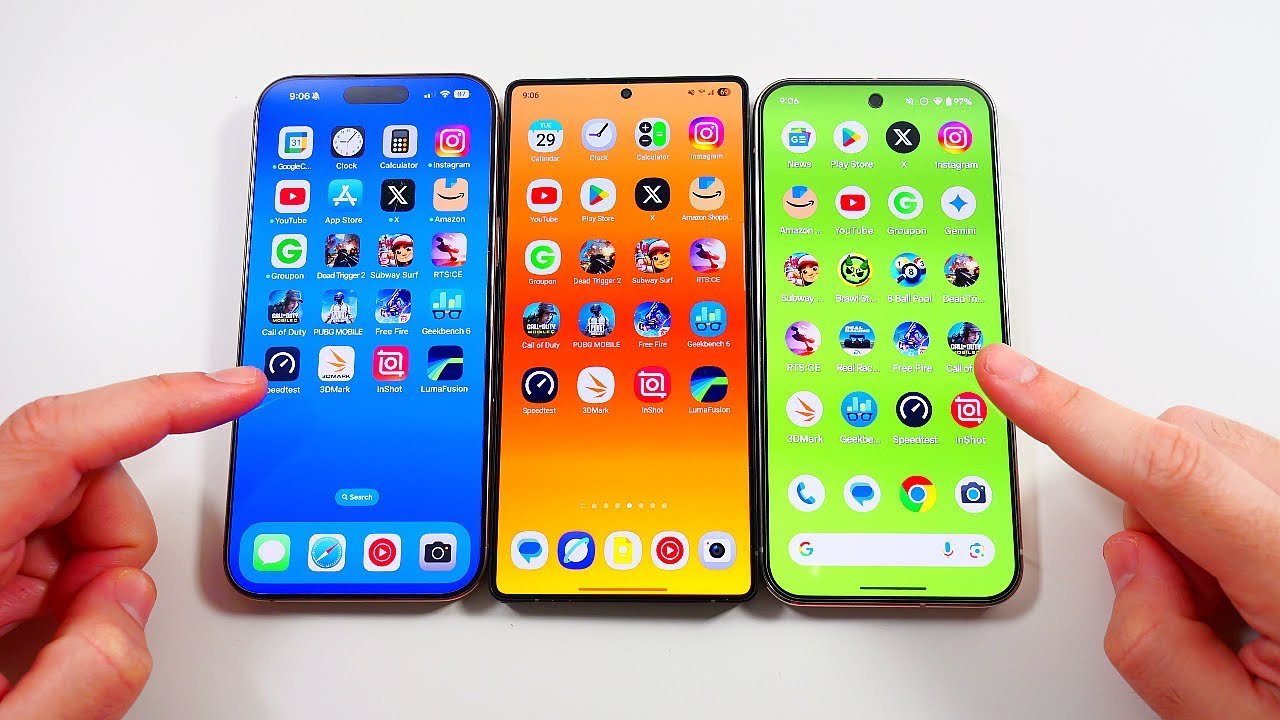
Apple’s quality control operates with remarkably low defect rates – typically under 2% for critical failures – because they manufacture in controlled facilities with strict oversight. Every iPhone undergoes the same rigorous testing regardless of price tier. Samsung, producing over 300 million phones annually across dozens of models, shows more quality variance. Their flagship S-series matches or exceeds iPhone quality, but budget A-series phones sometimes exhibit issues like screen uniformity problems or slower performance degradation.
- Build materials: iPhones use consistent premium materials (aerospace aluminum, surgical steel), while Samsung varies from plastic (A-series) to glass and metal (S-series)
- Display quality: Samsung actually manufactures iPhone displays and often debuts better screen tech in their own flagships first, giving Samsung a slight edge
- Durability: Both flagship lines score similarly in drop tests (6-8 feet survival rate), but iPhone’s Ceramic Shield provides better scratch resistance
- Water resistance: Comparable IP68 rating on flagships, but Samsung extends this to more mid-range models
Customer satisfaction surveys consistently show iPhone users reporting fewer hardware issues over 3+ years, with Apple achieving 92% satisfaction compared to Samsung’s 85%. However, Samsung’s display technology is objectively superior in specifications like brightness and color accuracy.
How Long Do iPhones Last Compared to Samsung?
Quick Answer: iPhones typically remain functional for 5-7 years with software updates, while Samsung phones last 3-5 years before becoming obsolete, though hardware durability is comparable.
The longevity gap comes primarily from software support rather than hardware failure. Apple provides iOS updates for an average of 6.5 years – the iPhone 8 from 2017 still received iOS 16 in 2022. Samsung improved significantly, now promising 4 years of OS updates and 5 years of security patches for flagship models, but older and budget models receive less support. Hardware-wise, both brands build phones that can physically last 5+ years with proper care.
- Software lifespan: iPhone receives 6-7 major iOS versions vs Samsung’s 4-5 Android versions on flagships, 2-3 on budget models
- Battery degradation: Both brands see similar 80% capacity after 500 charge cycles (roughly 2 years), but Apple’s battery replacement program is more accessible
- Performance aging: iPhones maintain smoother performance longer due to optimized iOS, while Samsung phones may lag after 2-3 years on older chips
- Repair availability: Apple offers service for devices up to 7 years old, Samsung typically supports repairs for 5 years
From a total cost perspective, using an iPhone for 6 years at $1,200 costs $200/year, while replacing a $700 Samsung every 3.5 years costs the same annually. The iPhone’s longer viability makes it financially competitive despite the higher purchase price.
✅ Best for: Users who want maximum longevity should choose iPhone 15 Pro or Samsung Galaxy S24 Ultra (both have 7+ year hardware potential)

Can Samsung Do Everything an iPhone Can Do?
Quick Answer: Samsung can perform most core functions but lacks Apple’s ecosystem integration features like AirDrop, iMessage, seamless device handoff, and cross-device continuity.
In terms of basic smartphone capabilities – calling, texting, browsing, photography, apps – Samsung matches or exceeds iPhone functionality. Samsung actually offers features Apple doesn’t, including expandable storage via microSD, split-screen multitasking, more customization options, and Samsung DeX for desktop-like experiences. However, the iPhone’s true advantage lies in ecosystem features that don’t have Android equivalents.
- Ecosystem features iPhone has: Universal Clipboard between devices, Handoff (continue tasks across devices), AirDrop, iMessage with effects and features, Find My network, Family Sharing, Continuity Camera
- Samsung-exclusive features: DeX mode, Edge Panel shortcuts, Secure Folder, Galaxy ecosystem integration (Watch, Buds, Tab), Knox security platform, Bixby Routines automation
- Features both have: High-quality cameras, 5G, wireless charging, NFC payments, biometric security, health tracking with wearables
The key question is whether you value Apple’s seamless integration with Mac, iPad, and Apple Watch, or Samsung’s flexibility and feature richness. If you own multiple Apple devices, the ecosystem integration is genuinely valuable. If you use Windows PCs or prefer Android’s openness, Samsung provides more features for less money.
🎯 Our recommendation: Choose iPhone if you own a Mac or iPad, choose Samsung if you use Windows or want more customization freedom
Is iPhone More Secure Than Samsung?
Quick Answer: Both platforms offer excellent security, but iPhone’s closed ecosystem and stricter app review process provide slightly better protection against malware and data breaches.
Security differences between iPhone and Samsung have narrowed significantly in recent years, but some key distinctions remain. Apple’s iOS operates as a closed system with all apps requiring review before App Store approval, while Android’s open nature allows sideloading and third-party app stores. This makes Android theoretically more vulnerable, though Samsung’s Knox security platform adds enterprise-grade protection that rivals iOS.
- Malware risk: iOS sees virtually zero malware in the wild (0.02% infection rate) compared to Android’s 1-2%, though Samsung’s Knox reduces this substantially
- Privacy controls: iOS 17 offers more granular privacy settings and App Tracking Transparency, while Samsung relies on Android’s improving but less restrictive permissions
- Data encryption: Both use AES-256 encryption; Samsung’s Knox creates a separate encrypted container for sensitive data
- Biometric security: Face ID (iPhone) and ultrasonic fingerprint (Samsung) both offer highly secure authentication
- Update speed: iPhone users receive security patches simultaneously worldwide, while Samsung updates roll out over weeks or months
For average consumers, both platforms provide sufficient security. For users handling sensitive information or in high-risk professions, iPhone’s more locked-down approach offers marginally better protection. Samsung’s Knox platform, however, meets government security certifications and is approved for classified communications in many countries.
⚡ Quick tip: Regardless of platform, enable two-factor authentication, use strong passwords, and keep your device updated for maximum security

Do I Need a Mac to Use an iPhone Properly?
Quick Answer: No, iPhones work perfectly as standalone devices, but owning a Mac unlocks additional continuity features like Universal Clipboard, Handoff, and AirDrop that enhance the experience.
This is a common misconception – iPhones function completely independently and don’t require any other Apple products. You can set up, use, and maintain an iPhone using only the phone itself and cloud services. However, Apple designs meaningful integrations between devices that provide genuine convenience if you invest in multiple products. Approximately 35% of iPhone users also own a Mac, suggesting most users don’t consider it necessary.
- Features that work without Mac: All core functions, iCloud sync, App Store, iMessage, FaceTime, Photos, Music, all third-party apps, Windows compatibility via iTunes/iCloud for Windows
- Mac-enhanced features: Copy on iPhone, paste on Mac; answer iPhone calls on Mac; send texts from Mac; Continuity Camera (use iPhone as webcam); Sidecar (iPad as second screen)
- Alternative solutions: Google Drive/Photos work across platforms, Microsoft Phone Link connects iPhone to Windows (limited), third-party apps fill many gaps
The ecosystem premium makes most sense when you already own other Apple products or plan to invest long-term in the platform. If you use Windows exclusively for work, you won’t miss the Mac integration features – the iPhone remains an excellent standalone smartphone.
💰 Price consideration: iPhone ($799) + Windows PC ($600) costs less than iPhone ($799) + MacBook Air ($1,099), so don’t feel pressured to buy Mac unless you need macOS specifically
What’s Better for Value: iPhone or Samsung Galaxy?
Quick Answer: Samsung offers better immediate value with more features per dollar, while iPhone provides better long-term value through longevity and resale value for users keeping devices 4+ years.
Value depends entirely on your definition and usage timeline. Based on features-per-dollar at purchase, Samsung wins decisively – a $799 Galaxy S24 includes a 120Hz display, 50MP main camera with 3x optical zoom, faster charging, and more RAM than the $799 iPhone 15. However, when calculating total cost of ownership over 4-5 years including resale value, the gap narrows or reverses.
- Best immediate value (year 1-2): Samsung Galaxy S23 FE ($599) offers flagship features at mid-range price, significantly outvaluing any iPhone in this price range
- Best long-term value (year 4-6): iPhone 15 Pro ($999) retains $550-600 resale value after 3 years, while Galaxy S24+ ($999) retains $350-400, making iPhone effectively $200-250 cheaper over time
- Best budget value: Samsung Galaxy A54 ($449) provides more features than iPhone SE ($429) including better display, battery, and camera
- Best overall value: iPhone 15 ($799) or Galaxy S24 ($799) both offer excellent value at identical prices – choose based on ecosystem preference
Factor in your upgrade cycle: if you switch phones every 2 years, Samsung’s lower upfront cost wins. If you keep phones for 5+ years, iPhone’s extended software support and higher resale value deliver better total value.
🎯 Our pick: For maximum value, buy previous-generation flagships – iPhone 14 Pro ($799 refurbished) or Galaxy S23 ($649 new) offer flagship performance at substantial savings
Why Do iPhones Hold Their Value Better Than Samsung?
Quick Answer: iPhones retain 55-65% of original value after three years compared to Samsung’s 35-45% due to brand strength, longer software support, and consistent product quality.
The resale value gap represents one of iPhone’s most significant economic advantages. A $1,000 iPhone 13 Pro sells for approximately $650-700 after two years, while a $1,000 Galaxy S22 Ultra fetches only $400-450 – a $250 difference that partially offsets the higher purchase price. This happens due to several interconnected factors in the secondary market.
- Software longevity: Buyers know a 3-year-old iPhone still receives updates, making it a safer purchase than an equally-old Samsung nearing end-of-support
- Brand perception: Apple’s luxury positioning maintains desirability even for older models, similar to how Mercedes holds value better than equally-capable competitors
- Market demand: Higher new prices create more demand for used iPhones as budget alternatives, while cheap new Samsung options reduce used demand
- Consistent quality: Every iPhone model performs similarly, while Samsung’s wide model range creates confusion about which used models are worth buying
- Ecosystem lock-in: Users invested in iCloud, iMessage, and Apple services face switching costs, keeping demand high for used iPhones
This resale advantage effectively reduces iPhone’s true cost. A $1,200 iPhone used for 3 years then sold for $720 costs $480 in depreciation. An $800 Samsung sold for $320 costs $480 in depreciation – identical despite the $400 price gap.
⚡ Quick tip: Buy certified refurbished iPhones directly from Apple for the best value – you get like-new devices with warranty at 15-20% discounts
How to Decide Between iPhone and Samsung for Your Needs?
Quick Answer: Choose iPhone if you value simplicity, ecosystem integration, and longevity; choose Samsung if you want more features, customization, and better immediate value.
Making the right choice requires honest assessment of your priorities and usage patterns rather than following brand loyalty. Both platforms have matured to the point where neither represents a objectively bad choice – the decision hinges on your specific circumstances and preferences. Consider these key decision factors based on real-world usage patterns.
- Choose iPhone if you: Own other Apple devices (Mac, iPad, Watch), value simplicity over customization, plan to keep your phone 4+ years, prioritize video recording quality, want guaranteed software updates, appreciate consistent app quality, rely heavily on iMessage, prefer minimalist design
- Choose Samsung if you: Use Windows PCs, want more features for less money, need expandable storage, prioritize display quality, prefer Android’s flexibility, upgrade phones every 2-3 years, want faster charging and higher zoom cameras, enjoy customizing your experience, need multitasking features
- Both are equally good if you: Primarily use your phone for basic tasks (calling, texting, social media, browsing), don’t care about ecosystem integration, have a budget of $799+ for flagship experience, want excellent camera quality, need 5G and modern features
Additionally, consider your budget timeline: if you can afford $1,000+ upfront and keep devices long-term, iPhone makes financial sense. If you prefer lower upfront cost or upgrade frequently, Samsung’s pricing structure suits you better. Test both platforms in-store if possible – user interface preference often overrides all other factors.
🎯 Our recommendation: If truly undecided, choose based on which ecosystem your family and friends use – shared features like easy photo sharing and app recommendations create real value

Quick Comparison Table
| Feature | iPhone 15 Pro | Samsung Galaxy S24+ | Winner |
|---|---|---|---|
| Starting Price | $999 | $999 | Tie |
| Software Updates | 6-7 years | 4-5 years | iPhone |
| Display | 6.1″ 120Hz OLED | 6.7″ 120Hz AMOLED | Samsung |
| Camera Zoom | 3x optical | 3x optical | Tie |
| Charging Speed | 20W wired | 45W wired | Samsung |
| Storage Options | 128GB-1TB | 256GB-512GB + microSD | Samsung |
| Resale Value (3yr) | ~$600 (60%) | ~$400 (40%) | iPhone |
| Video Quality | ProRes, Cinematic | 8K recording | iPhone |
| Ecosystem Integration | Excellent with Apple | Good with Samsung/Android | iPhone |
| Customization | Limited | Extensive | Samsung |
| Best For | Long-term users | Feature seekers | Depends |
Expert Tips for Maximum Value
- Buy previous generation: The iPhone 14 Pro and Galaxy S23 offer 90% of current flagship performance at $200-300 less, representing the sweet spot for value-conscious buyers
- Consider certified refurbished: Apple’s refurbished iPhones come with full warranty and new battery, offering 15% savings with zero risk – better than buying new budget models
- Calculate total cost of ownership: Always factor in resale value when comparing prices – subtract expected resale value from purchase price to find true cost over your ownership period
- Wait for carrier deals: Samsung phones often see $400+ trade-in offers within 3-4 months of launch, while iPhone deals are smaller but more consistent throughout the year
- Match the ecosystem: If you already own a MacBook, Apple Watch, or AirPods, the iPhone integration adds $300+ worth of convenience features that justify the premium
- Ignore marketing specs: More megapixels or RAM don’t guarantee better real-world performance – both platforms optimize differently, making spec comparisons misleading
- Test the ecosystem: Borrow a friend’s device for a week or use the 14-day return policy to actually experience the ecosystem before committing to the more expensive option
Common Mistakes to Avoid
- Mistake 1: Comparing launch prices only – Samsung phones drop $200-400 in value within 6 months, while iPhones hold steady, meaning actual purchase prices differ significantly from MSRP comparisons
- Mistake 2: Buying for the wrong ecosystem – An iPhone works poorly if you use Windows, Google services, and Android tablets; similarly, Samsung underperforms if you own a Mac and iPad
- Mistake 3: Overpaying for storage – Apple charges $100-200 per storage tier upgrade; Samsung offers microSD support on many models, potentially saving $200 by using a $30 memory card
- Mistake 4: Ignoring software support timelines – Buying a 2-year-old Samsung model means only 2-3 years of updates remaining, making it obsolete quickly despite initial savings
- Mistake 5: Assuming more expensive equals better – The $1,199 iPhone 15 Pro Max isn’t objectively superior to the $799 iPhone 15 for most users – flagship features rarely justify the $400 premium for typical use cases
Final Thoughts
The iPhone-Samsung price debate ultimately comes down to whether you value features now or value later. Samsung delivers more specifications, flexibility, and immediate functionality per dollar spent, making it the obvious choice for feature-conscious buyers or those on tighter budgets. iPhone justifies its premium through superior software longevity, ecosystem integration that genuinely saves time, and resale value that reduces long-term costs for users planning 4+ year ownership cycles.
Neither choice is objectively wrong – approximately 50% of US smartphone buyers choose iPhone while the other half selects Android devices including Samsung, proving both approaches serve different users successfully. The best phone isn’t the one with more features or higher price, but the one that aligns with your existing tech ecosystem, matches your upgrade timeline, and fits your actual usage patterns rather than aspirational ones.
Ready to make your decision? Consider your current devices, honest upgrade timeline, and which features you’ll actually use daily. If you own Apple products and keep phones 4+ years, choose iPhone for better integration and longevity. If you use Windows, want more features immediately, or upgrade every 2 years, Samsung delivers superior value. Both are excellent devices – choose based on your ecosystem and timeline, not brand loyalty.
Remember: The best value comes from buying what you’ll actually use fully rather than paying for features you’ll never need or compromising on integrations you use daily.